Party Icon Line Art Set
A Designer’s First Glance: Light, Playful, and Purposefully Minimal
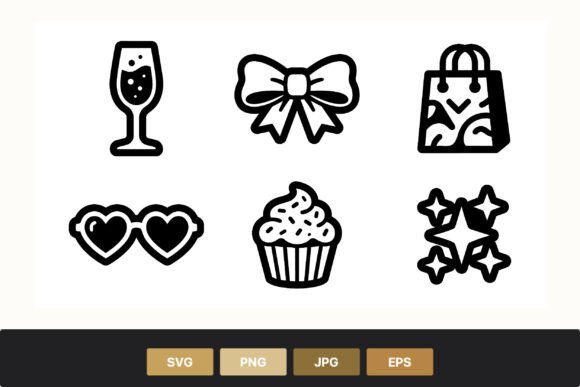
Opening the Party Icon Line Art Set feels like flipping through a well-curated sketchbook—clean, confident, and quietly joyful. Six icons: champagne glass with delicate rising bubbles, a soft decorative bow, a patterned shopping bag with subtle texture, heart-shaped sunglasses (a wink of personality), a sprinkled cupcake with just enough detail to read as sweet—not saccharine—and sparkling stars drawn with intentional asymmetry. No shading, no gradients—just crisp black outlines on white vector art. The mood? Effortlessly celebratory without leaning into cliché. It’s not “birthday party” or “baby shower” by default—it’s *celebration* in its most versatile form. That makes it unusually flexible for embroidery designers who need one design set to serve baby onesies, boutique tote bags, bridal shower napkins, and Etsy-ready digital mockups—all without visual whiplash.
How It Stitches: Clarity Over Complexity
I tested the champagne glass icon on a medium-weight cotton twill tote bag—standard 4” hoop, tear-away stabilizer, 40-weight polyester thread. What stood out wasn’t just how cleanly it stitched, but how *readable* it stayed at small scale. The bubbles are spaced generously; the glass stem has clean tapering lines—not too thin, not too thick. Same with the bow’s loops and the cupcake’s swirl: they translate beautifully into running stitch and satin stitch borders without collapsing or bleeding. This isn’t a dense fill-stitch design—it’s line art first, which means lower stitch density, faster sew-out, and less risk of puckering on lightweight or textured fabrics like linen tea towels or baby knit onesies.
That simplicity becomes an asset across real projects: a single heart-sunglasses icon works perfectly centered on a toddler’s organic cotton cap (no distortion on the curved crown); the sparkling stars scatter nicely across a nursery pillow cover in varied sizes; the shopping bag icon reads clearly even at 1.5” tall on a patch backing for a craft fair apron. For sweatshirt embroidery, I’d pair the bow or stars with a short custom name—no crowding, no visual competition. And because it’s vector-based, scaling up for a large kitchen towel monogram or down for a delicate baby bib is genuinely seamless—no pixelation, no jagged edges.
Where It Shines—and Where to Pause
The Party Icon Line Art Set thrives in contexts where charm and clarity matter more than photorealism. Think: personalized gifts that feel handmade, not mass-printed; small shop merchandise that stands out on Instagram feeds; Etsy listings where clean line art photographs beautifully in natural light; holiday embroidery that avoids dated motifs; and commercial embroidery jobs where clients want modern, gender-neutral, ageless celebration visuals.
That said—real talk—avoid pushing these icons into tight corners. On stretchy fabric like jersey tees, test the bow or cupcake first: fine loops and curves can distort if stabilizer isn’t firm enough. On dark fabric, confirm your thread contrast—black-on-black won’t read, and white-on-navy needs sharp tension control. Tiny hoops under 3” may lose subtlety in the champagne bubbles or star points—scale down thoughtfully, not automatically. And while the line art style forgives minor alignment hiccups, don’t place the bow directly over seam allowances on structured garments—it’s best centered on flat, stable panels.
What It Adds to Your Finished Product
Customers notice intention. A hand-selected, well-executed icon like those in the Party Icon Line Art Set signals care—not just in stitching, but in curation. It lifts perceived value: a plain canvas tote becomes a boutique-worthy gift when embroidered with the patterned shopping bag icon in ivory thread. A simple baby onesie gains quiet sophistication with a single sparkling star near the shoulder. For Etsy sellers, this set supports strong branding consistency across product categories—same visual language on digital mockups, printed tags, and physical embroidery. And because it’s illustration-led (not photo-based), it integrates smoothly into printable mockups and social media assets without licensing friction.
Practical Notes from the Hoop
Before cutting thread or loading your machine:
- Test on scrap fabric—especially if using textured weaves, knits, or blends. Line art relies on edge definition, and fabric tooth can blur fine strokes.
- Review stitch density—even minimal designs can over-stitch if converted poorly. Look for smooth transitions between straight runs and gentle curves.
- Check thread color contrast on both light and dark backgrounds. These icons were built for high legibility—but only if your thread doesn’t recede into the fabric.
- Confirm hoop size compatibility. While scalable, some icons (like the full shopping bag) benefit from a 5”+ hoop for optimal tension and stitch flow.
- Inspect small details at actual sew-out size: Are the cupcake sprinkles distinct? Do star points stay sharp? Zoom in before finalizing.
- Try black-and-white mockups first—this set was designed for monochrome impact, so grayscale previews tell you more than colorful ones.
- Use appropriate stabilizer: medium cut-away for knits, tear-away for stable wovens, fusible for lightweight silks or voiles.
- Verify licensing before selling finished items or bundling the files digitally—this is a Graphics asset, not clipart, and commercial use terms matter for craft businesses and Etsy sellers.
Final Thought: Less Is Celebrated
In a landscape crowded with overdesigned, overly literal party graphics, the Party Icon Line Art Set stands out by doing less—and meaning more. It doesn’t shout “party!” It invites the viewer in with wit, balance, and restraint. As an embroidery designer, I reach for it when I want my work to feel considered, not cluttered; when my client wants something that says “thoughtful gift,” not “generic decoration”; and when my own craft business needs design assets that look equally at home on a handmade baby blanket, a small-batch apron, or a polished digital product listing. It’s not flashy—but it’s memorable. And in embroidery, where every stitch carries weight, that kind of quiet confidence is rare, valuable, and deeply practical.