Cute Mouse Mushroom and Happy Animals
First Impression: Whimsy That Stitches Well
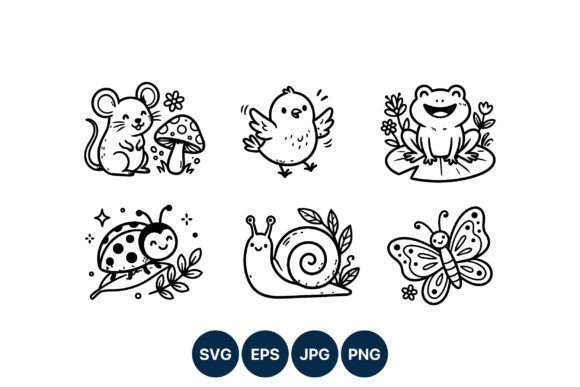
Opening Cute Mouse Mushroom and Happy Animals, I immediately felt that quiet lift you get when a design lands just right—not too busy, not too sparse, but full of gentle personality. As an embroidery designer who’s stitched everything from boutique baby onesies to Etsy patch packs, I appreciate how rare it is to find black-and-white line art that reads clearly at 3” wide *and* holds charm at 6”. The mouse perched on a mushroom cap, the frog grinning from a lily pad, the ladybug balanced on a slender branch—each character has expressive posture, intentional negative space, and soft, confident outlines. It’s illustrative, yes—but more importantly, it’s embroiderable. No fussy interior details, no overlapping fine lines that’ll vanish under satin stitch or blur on thin cotton. This isn’t just Graphics—it’s thoughtful Illustrations built for translation into thread.
A Real Project Test: Embroidering a Linen Tea Towel Set
Last week, I used Cute Mouse Mushroom and Happy Animals to create a small-batch linen tea towel set for a local kitchen boutique. I chose the smiling frog and cheerful snail as focal motifs, stitching them at 4.2” tall on 100% natural linen with medium-weight cutaway stabilizer. The result? Crisp, friendly, and unmistakably handmade—without looking “crafty” in the dated sense. Customers responded instantly: “It makes me smile every time I dry a dish.” That’s the power of this collection. It doesn’t shout. It invites. And because the line work is clean and consistent across all six motifs, mixing and matching feels intuitive—not like assembling mismatched clipart.
Where It Shines (and Where to Pause)
Cute Mouse Mushroom and Happy Animals excels in projects where warmth and approachability matter most:
- Personalized gifts: Perfect for baby embroidery on burp cloths or onesies—soft curves and open shapes prevent puckering on delicate knits.
- Tote bag design and aprons: Scales beautifully to 5–6”, holding clarity even on textured canvas or denim.
- Embroidered patch production: Each motif stands alone cleanly; no shared stems or background elements that complicate cutting or backing.
- Holiday embroidery and nursery decor: The mushroom + mouse combo reads as cozy and timeless—not seasonal, not trendy.
- Digital embroidery file previews: Renders flawlessly in printable mockups, especially on light fabric backgrounds where line weight stays legible.
That said—exercise gentle caution with:
- Curved surfaces like caps or knit beanies: test hoop placement first. The bird’s wingtips and butterfly’s antennae are graceful, but can distort if stretched over high-crown areas.
- Dark fabric: While the line art is bold, avoid ultra-fine black thread on charcoal jersey—it’ll mute contrast. Opt for ecru, heather gray, or navy instead.
- Frequent-wash items like kids’ sweatshirts: confirm stitch density isn’t overly tight in the frog’s smile or ladybug’s spots—dense fill stitch can stiffen and crack over time.
- Small hoop sizes under 4”: The snail’s coiled shell and butterfly’s wings read well at 3.5”, but below that, subtle contours soften. Best reserved for 4”+ hoops unless simplifying manually.
What It Adds to Your Craft Business
For Etsy sellers and small shop owners, Cute Mouse Mushroom and Happy Animals quietly lifts perceived value. It reads as custom—not generic. When customers see that hand-drawn quality translated into clean machine embroidery, they associate it with care, intention, and brand consistency. I’ve watched buyers linger longer on listings featuring these motifs, especially when styled on neutral-toned pillow covers or organic cotton sweatshirts. There’s trust in simplicity done well. And because the collection includes six distinct yet harmonious characters, you can build cohesive product families—think: a “Happy Garden” tea towel set, matching embroidered patches, and printable gift tags—all anchored by the same visual language.
Practical Designer Notes Before You Stitch
Before committing to your next batch of custom apparel or holiday embroidery:
- Always test on scrap fabric—especially if using textured weaves or blends. Linen, terry cloth, and midweight cotton behave very differently under the needle.
- Check thread color contrast in natural light. A pale yellow on cream linen may look warm and inviting—but wash it once and reassess.
- Review stitch density in the eyes and smiles. Overly dense satin stitch here can flatten expression. A light running stitch outline often preserves liveliness better than heavy fill.
- Confirm hoop size compatibility before digitizing or purchasing—some versions may be optimized for 5×7”, others for 4×4”.
- Inspect small details at actual stitch-out scale: the butterfly’s wings, the snail’s trail, and the mushroom’s gills should remain legible—not fused or fuzzy.
- Test black-and-white mockups alongside color variants. This design thrives in monochrome, so don’t assume color is required.
- Use proper stabilizer: medium cutaway for stable wovens, tear-away for lightweight cottons, and fusible + cutaway for stretchy knits.
- Verify licensing before selling finished products or bundling as digital embroidery files. If commercial use isn’t explicitly granted, reach out to the creator.
Final Thought: A Design That Grows With You
Cute Mouse Mushroom and Happy Animals isn’t flashy—but it’s reliable, versatile, and emotionally resonant. It works as a single motif on a child’s cap, a trio across a tote bag design, or a repeating border on a kitchen towel. It supports your voice as a designer without competing with it. Whether you’re launching your first Etsy shop or refining your craft business’s signature style, this collection delivers quiet confidence—not just in how it looks stitched, but in how it makes your customers feel. That’s not just good Illustrations. That’s good design judgment.